


 Kathryn Sears
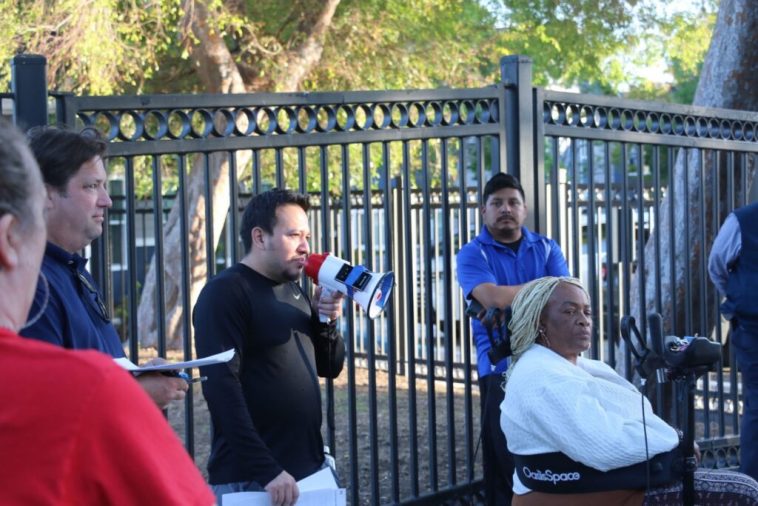
Around two dozen tenants gathered at the leasing office of Monterey Pines Apartments, a low-income housing complex in Richmond, last month, voicing grievances and asking city officials to take action.
Organizers had requested permission to congregate in the community center, but the property manager denied the request. So they stood outside, airing their concerns as children ran around and swung on the fence surrounding the closed community swimming pool.
District City Councilmember Sue Wilson, and Lina Velasco, head of the Richmond Residential Rental Inspection Program, listened to the long list of complaints: mold, rotting balcony posts, broken heaters and windows, pest infestation, and communal areas — including laundry facilities and the pool — in disrepair.
Many of these issues had been going on for months, years, and in some cases, decades, but it wasn’t until last November when the property owners suddenly began charging utility fees in the range of $150 to $300 a month, that tenants began to organize.
Since then, they have demanded that management reimburse the utility fees, which their lawyers say amount to an illegal rent increase. Tenants also asked the city’s Rent Board to repeal regulations that impede their access to Richmond’s rent control law, and decried the failure of management and ownership to provide habitable living conditions.
In February, the Richmond Rent Board agreed to investigate Monterey Pines and other low-income housing properties, based on tenants’ complaints of illegal rent increases. And in April, MRK Partners, the Southern California-based real estate company that owns the property, sent a letter to tenants assuring that it would refund utility bills and prioritize repairs.
The letter also stated that utility fees would cease immediately. However, tenants at the May rally said they had not seen any material change in their living conditions and many still had received a bill for utilities on the first of the month. This month, tenants saw the charges removed, and they were not charged for utilities in June.
Velasco said more than half of the 80 or so Monterey Pines units the city has inspected have failed to pass. If management doesn’t make the necessary repairs, the city is prepared “to escalate to the next level,” she said. The city could apply for an abatement warrant, which would allow it to proceed with property repairs and pass the bill onto the property owners.
Monterey Pines Apartments, on South 37th Street at Stege Avenue, was purchased by MRK Partners in 2016 under a federal program that distributes tax credits to owners who offer low-income housing. It consists of 324 units, 259 of which are designated for low-income residents, allowing the owners to receive $1.5 million annually in tax credits.
Rents range from $1,500 to $2,300 for a two bedroom, one-bath apartment, according to the company website. Low-income properties are required to base rent on a percentage of the area median income, which is $168,000 in Contra Costa County.
“Everyone thinks that if you live in affordable housing, you’re not paying more than 30% of your income,” said Leah Simon-Weisberg, executive director of Movement Legal, a nonprofit legal service working with tenants and the city. “That’s not how these properties work at all.”
Monterey Pines residents saw the first sign of new utility fees in September, when they received notices stating that failure to agree to the new terms could result in immediate eviction. The notice stated there would be a change in how utilities would be charged. It did not include how these fees would be calculated, how much they might be, or offer a name, phone number, or any contact information for a representative who could answer tenants’ questions.
Juan Carlos Posada, who has lived at Monterey Pines for 11 years, signed, as most tenants did. At the time, his rent was just over $1,600 a month.
In November, tenants received their new utility bills, some as high as $300, on top of their rent, which had gone up that year and had already included utilities, Posada said. For him, this represented a nearly 20% increase in rent.
He sent an email to management in December about the utility bill and numerous outstanding work orders. When his emails went unanswered, he spoke to the manager in person. Despite promises, there was no movement to lower the bill or make repairs, he said.


It was then that Posada decided to take action. He attended a tenants’ rights meeting held by the Alliance of Californians for Community Empowerment, and then a second meeting, to which he invited his neighbors.
In January, around 50 people attended an ACCE meeting at Monterey Pines, the biggest turn out the organizers had ever seen, said Simon-Weisberg.
Company reverses course
Lawyers from Movement Legal told tenants the new utility bills violated regulations under the California Tax Credit Allocation Committee, which administers low-income housing tax credit programs. They said the lack of detailed information provided about how the fees would be levied or calculated and the absence of contact information on the original notice also violated state regulations, according to a March letter drafted by Movement Legal that tenants served to the property managers and MRK Partners. The letter said the utility charges were illegal and demanded that management refund fees collected since November, threatening litigation if demands were not met.
At the beginning of April, tenants received a letter from management stating that utility charges would cease immediately and they would be reimbursed for the prior charges by May 1. In addition, the letter said the property management company, WinnResidential, would prioritize maintenance and work toward resolving all work orders over the following two months.
Asked to comment on the tenants’ claims, Javon Cruz, the on-site property manager for WinnResidential, a Boston company that manages about 60,000 apartments across the country, referred all questions to the media team.
Ed Cafasso, a WinnResidential spokesperson, said Monterey Pines has been consistently in compliance with Tax Credit Allocation Committee rules since MRK acquired it. “Ownership communicates directly with the state officials who enforce these regulations on a regular basis, as well as when questions arise, to ensure that we maintain compliance,” Cafasso said.
The utility bills would have violated a Rent Board resolution that caps rent increases to 5% annually at properties receiving a low-income housing tax credit, like Monterey Pines, according to Movement Legal’s demand letter. The letter also says that under federal rules governing the tax credit program, utility bills are part of a tenant’s gross rent. Charging Monterey Pines residents separately for utilities essentially increased rents by more than 10%, and, in some cases, more than 20%, the letter said.

Monterey Pines tenants asked the Richmond Rent Board in February to repeal regulations passed in 2017 that allow low-income property owners such as MRK Partners to apply for an exemption from Richmond’s rent control ordinance.
Lawyers from Movement Legal argued that the Rent Board acted outside of its authority as a regulatory agency by contradicting the original language of the law.
“It’s just not acceptable that you’ve got the most vulnerable tenants with no support when the ordinance clearly says that they’re covered,” Simon-Weisberg said in an interview. “The reason I’m so indignant about this is because I wrote the ordinance in Richmond. And so I was very conscious that it was supposed to cover affordable housing.”
In response, the Rent Board voted to temporarily suspend exemption applications to additional low-income property owners and authorize an investigation through the Rent Program, which administers Richmond’s Fair Rent law. The board did not repeal the existing exemptions.
Posada decided to withhold the fees that appeared in his balance at the beginning of May. He received an email on May 12 saying the charge was an accident that would be remedied. As of June, Posada said all fees had been removed from his account.
Waiting for repairs
Emily Velez, who has lived at Monterey Pines for eight years, also refused to pay her balance, which she says is inaccurate. Velez has been organizing neighbors, passing out flyers, and offering to translate for Spanish-speaking residents.
Velez said that her over $2,500 balance included rent payments that she already made and has receipts for. While the utility fees for prior months had been reimbursed, Velez received another utility bill for $266 on May 1. That bill later was removed from her account and this month, she was not charged for utilities.
“It’s really affecting my mental health,” said Velez, who is struggling to support two teenage daughters. “It causes me anxiety because I paid my rent.”
Many tenants are not optimistic that repairs are coming, and their experiences with management give them little reason for confidence.
Marissa Shaw, a Monterey Pines tenant since 2007, uses a wheelchair. When her bathroom stopped working earlier this year, she said management gave her a key to another ADA-accessible apartment on the other side of the property so that she could have a working bathroom.
Posada said he had waited seven months for power to be restored to his dishwasher and garbage disposal, which a previous repair person knocked out.
Prior to the repairs, which came in May, he had been running an extension cord from the living room to power the appliances. His oven also stopped working last fall. Despite email and in-person communication with management, those repairs never came. He was unable to cook Thanksgiving dinner with his kids, taking them out to eat instead. He said his oven remains broken. Stories like this are commonplace among Monterey Pines tenants.
Shericca Robinson, who lives with her daughter, said she had to call an exterminator to get rid of rats in her apartment, but the roaches are still “coming out by the pounds.”
She sent her infant granddaughter to live with a relative because the apartment had no heat all winter. “I didn’t want to have my grandbaby in here, you know, she kept getting sick,” Robinson said.
According to Cafasso, the company has hired two temporary maintenance technicians and a new regional maintenance manager, with the goal of completing pending work this month.
“We are prioritizing pressing maintenance and capital improvements that directly benefit resident households,” Cafasso said.

In January 2025, Richmond City Council directed the Rental Inspection Program to expand inspections to affordable housing units. Before this, the program only inspected affordable housing properties with four units or less.
Low-income properties like Monterey Pines are inspected every three to five years by the California Tax Credit Allocation Committee. Monterey Pines was last inspected in 2024. Out of the 41 units reviewed, 26 had deficiencies requiring corrective action — 22 deficiencies were classified as severe.
One of the most common findings of the inspection was smoke detectors that were broken or missing, 16 in total, though a fire had damaged 12 units a few months before the inspection.
The tenants who showed up to the May gathering at Monterey Pines, expressed frustration with the slow pace of change, but also gratitude to the organizers, the translators and city officials.
“ I’m hoping that they treat their tenants with better respect,” Sherrica Robinson said when asked why she had decided to come out and speak in front of the leasing office that day.
“Y’all are getting our money,” she said. “So why we can’t have proper housing?”

Kathryn is the main contributor to the quiz section of LaDailyGazette.com. If you have an idea for a quiz, let us know.