


 Kathryn Sears
By Lou Baudouin and Finneas Brumbaugh | Special to The OBSERVER
For Jennifer Blackwell, Sacramento parks are the only safe place she can get peace.
Blackwell is in the process of moving in with her son, but cannot stay with him because of leasing issues. As a result, she has spent three years living in Sacramento parks.
“Sometimes I sit right here because it’s the only place you can get light to read by,” Blackwell says. “It’s lit up and people are playing tennis here, so it’s safer for me because there’s more than one person.”
Blackwell is currently living in Jack N. Sheldon Park in South Sacramento, one of several Sacramento parks given a grant by the Statewide Park Development and Community Revitalization Program.
The program, also referred to as the Statewide Park Program, aims to revitalize or create new parks in underserved communities throughout California.
The program received $41.9 million in additional funds through the 2023-2024 California budget and is looking to increase that number to $190 million in the next fiscal year. Sheldon Park received $8.5 million to expand and improve lighting and many other amenities.
“Over the years, I’ve seen that the more we get into the Statewide Park Program, the more it proves that communities aren’t truly full and healthy unless they have a park element,” says Richard Rendón, who has worked with the California State Parks Office of Grants and Local Services for 25 years.
Rendón says the program considers places without at least three acres of parkland per 1,000 residents as underserved, along with other criteria for deciding how to distribute grants. These grants are intended to assist with building new amenities, such as playground equipment, increased lighting and sport fields.
The Statewide Park Program has served as a “bridge builder between underserved communities” and a source of access to park funding and construction, Rendón says. The program has run several rounds since its creation: two in 2010 and 2012, followed by additional rounds in 2018, 2019, and 2020.
Vincent King, planning manager for the Southgate Park district, is in charge of managing and planning out Nicholas Park and Sheldon Park, another park that recently received grant money. King emphasized how critical these investments are, especially for disadvantaged areas where access to open space historically has been limited.
“I think the state and legislature have done a really excellent job of directing the funds to areas of the most need,” King says.
A fifth round of funding is expected in 2026, pending completion of the rulemaking process. Rendón says that each round addresses the growing needs of the public. Each new round begins with public comment to guide priorities, ensuring the community’s ideas are integrated and giving it a sense of ownership and pride in local parks.
Public outreach has remained at the program’s core, with each project shaped by the voices of local residents and partners such as advocacy group Parks California.
Geoff Kish, vice president of programs for Parks California, says advocacy groups and other supportive programs are key to connecting parks with the communities they are placed in.
“We believe the strongest programs are those created in partnership with communities. Our Route to Parks program is a great example,” Kish says. “A great local park is a springboard to seeking out the amazing opportunities afforded by our state and national parks more broadly.”
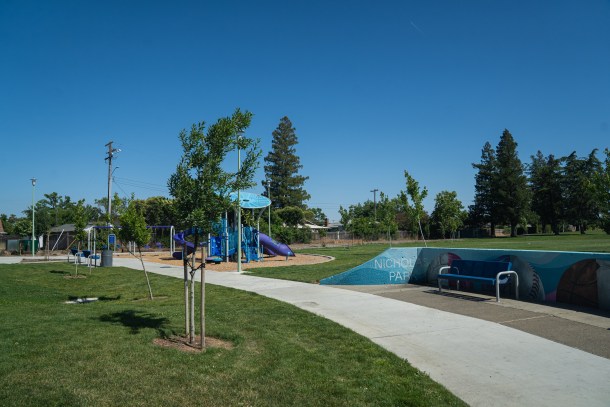
King says he has been involved since the third round in 2018, including work on Nicholas Park in the Southgate District. That project reflects how community engagement has shaped park evolution, from sports facilities to art installations.
“The Statewide Park Program was critical in improving this park. It wouldn’t have happened without it,” King says.
Erica Thomas, a muralist who worked on the Nicholas Park project, praised the collaboration and says the grant program alongside government support makes such efforts possible.
Community input directly shaped enhancements at Nicholas Park, addressing long-standing issues such as deteriorating baseball diamonds being replaced with soccer fields, multi-use courts, adult fitness equipment, playgrounds and shaded areas. Thomas’ mural was directly supported by grant money, King says.
“Public art in parks is a way to show the community that the space is cared for and that the people who use that space matter,” Thomas says.
King says parks and open spaces offer necessary relief from the “otherwise concrete jungle around us,” emphasizing the need for people to relax and connect in their communities.
Although new amenities are underway, ongoing challenges remain. These include limited funding, prioritizing high-need areas, and addressing long-term maintenance and safety issues. Rendón says safety tops the priorities, but there is not enough funding to address everything.
“We’ve had almost $8 billion in grant requests, and we’ve only been able to fund $1.2 billion of it,” Rendón says. “There are still a lot of places that have a really high need.”
Safety and maintenance are top concerns for both park officials and users. King notes that where money for improvement is scarce, so are funds for upkeep.
“In areas where it’s hard to get capital improvement dollars to improve a park, it’s also hard to [secure] the dollars to maintain them,” King says.
Blackwell highlights the contrast between the park’s atmosphere during the day versus at night. She says the lack of lighting and safety measures created opportunities for crime and put vulnerable people at risk.
“At night, it’s dangerous because a lot of the homeless predators come out and chase the women out,” she says of a specific nearby camp.
She says improving security, especially lighting, should be prioritized over adding new features since she has had experiences being attacked. Visitors such as Tim Nguyen use the park regularly for exercise when visiting family in the area. Nguyen also raised concerns about safety, particularly for children.
“I saw the needles here and there when the kids were running around,” Nguyen says. “The scary thing is if the needle has blood on it, you know? And if the kids touch it, it’s bad.”
King acknowledges the complexity of these issues, noting that physical upgrades and community engagement are important, but broader societal challenges must be addressed alongside them.
“Good activity brings more good activity,” King says. “If you’re able to create a nice, friendly, more welcoming space, then it brings those families and those folks that want to use it for the right purposes in.”
He shared plans for further improvements at Sheldon Park, including a new basketball court, lighting, and upgrades to the Florin Creek Trail. At Nicholas Park, lighting already has been strategically added along walkways where people gather.
Looking ahead, Rendón says the state is reviewing potential changes to the criteria for the program’s fifth round, with hopes of incorporating public input and continuing to expand access.
“The goal is to ensure every child in California has access to quality parks and recreation,” Rendón says.
EDITOR’S NOTE: This article was produced for The OBSERVER by Sacramento State journalism students under the guidance of nationally known data expert Phillip Reese.
Related

Kathryn is the main contributor to the quiz section of LaDailyGazette.com. If you have an idea for a quiz, let us know.