


 Kathryn Sears
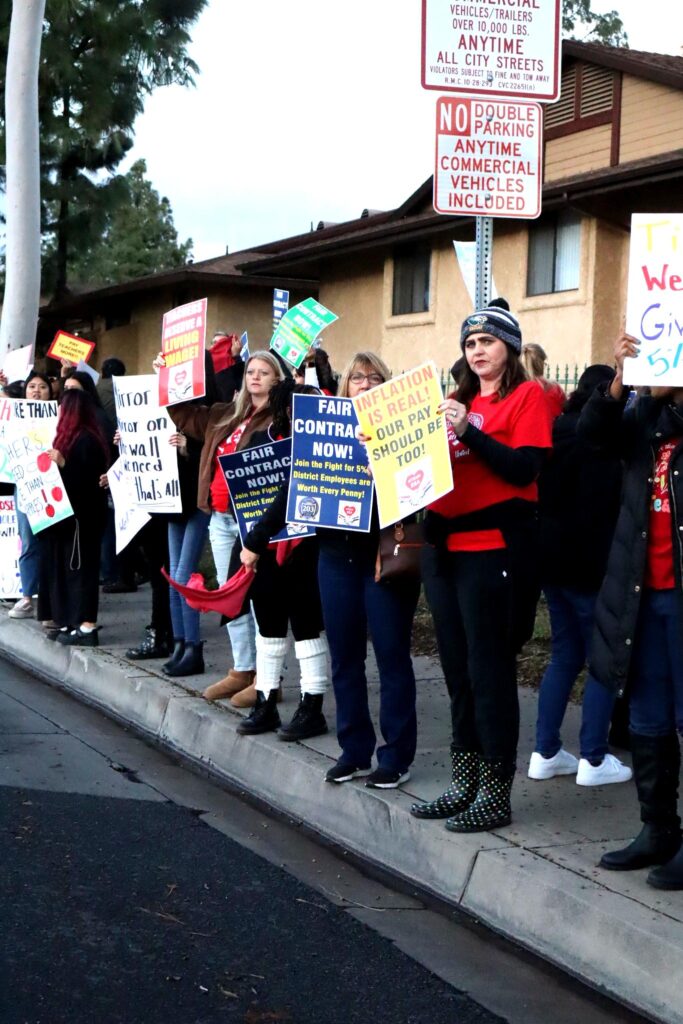
Two unions representing employees in the Rialto Unified School District say the district is sitting on more than $200 million in reserves while holding firm on a 3% raise offer they argue is worsening staffing shortages, increasing workloads and disrupting student learning.
Leaders of the Rialto Education Association and California School Employees Association Chapter 203 spoke with Inland Empire Community News on March 2, outlining their concerns after nearly a year of contract negotiations.
Tobin Brinker, president of the Rialto Education Association, said negotiations with the district have lasted about 11 months and remain stalled over pay.
“We have been negotiating with the school district for our contract for almost a year now,” Brinker said. “Since we first sunshined our proposals, the district has drawn a hard line at a 3% salary increase. We believe teachers should be paid 5%.”
Brinker said the union tracks 33 comparable school districts across San Bernardino and Riverside counties and estimates Rialto teachers are about 2.7% below the regional average settlement over the past decade.
He said inflation and delayed raises have made the gap more noticeable for educators already struggling with the cost of living.
“When inflation went up a few years ago, the state put a whole bunch of money into schools to help attract and retain teachers,” Brinker said. “Salaries were already low, and when inflation hit, it really devastated a lot of folks in our profession.”
Christine Acosta, president of California School Employees Association Chapter 203, said classified employees — including custodians, office staff and support workers — are facing similar challenges.
Her union is seeking a 3.75% raise while the district has remained at 3%.
“We’re only asking for 3.75, and they’re stuck at 3% for us,” Acosta said. “They won’t even move the additional 0.75.”
Both union leaders pointed to Rialto Unified’s financial reserves as a central issue in the negotiations. The district’s 2024–25 unaudited financial report shows a total ending fund balance of roughly $204.6 million.
Brinker said the unions believe that money should be used to support employees and students now rather than being held in reserve.
“When districts get money, it’s meant to be for the kids who are here right now,” Brinker said. “What we’ve discovered is that Rialto is not using that money on the kids who are here right now. They’ve been stashing it.”
Acosta said staffing reductions have also increased workloads for remaining employees. She pointed to layoffs and eliminated positions at the end of the last school year, including custodial and mailroom roles.
“At the end of June, they let go of several classified positions — two custodial positions, the mailroom position and the teacher resource center position,” Acosta said. “Now they’re expecting the people who are left behind to take over those duties.”
Acosta said the removal of mailroom staff has also affected how important district communications are sent to families.
“There were two people in the mailroom — a specialist and a courier assistant,” she said. “The courier assistant delivered mail and packages to school sites, and the specialist handled bulk mailers and compliance letters that needed to go out to parents.”
“Since I left in June, there’s nobody doing that work,” Acosta added. “Parents are not getting the appropriate notifications by mail.”
Brinker said staffing shortages have also affected classrooms. He said the union tracked hiring during the current school year and found that 46 teachers were hired before school began and 47 were hired after the school year had already started.
“Over half of the people hired to fill vacancies this year were hired after the school year started,” Brinker said. “That has an impact on kids.”
He said students sometimes begin the year in overcrowded classrooms or with substitute teachers before permanent hires are made.
“At an elementary school you might have 32 or 34 kids in a classroom,” Brinker said. “Then when they finally hire someone, students get moved into a new class and have to learn new routines. That disruption affects learning.”
Brinker said rotating substitute teachers can also create inconsistency for students.
“You might have a class that has sub after sub after sub,” he said. “Some substitutes are excellent, but others simply pass out papers and take attendance. In those cases, there’s not a lot of learning.”
Acosta said financial pressures have also pushed many classified employees to work multiple jobs.
“I know custodians personally who work two eight-hour shifts,” she said. “They work nights for Rialto and have a day shift custodial job somewhere else just to make ends meet.”
She said instructional aides often work additional hours through after-school programs.
“Some aides go from the classroom to the after-school program and work until about 6 p.m.,” Acosta said.
Brinker said housing costs have forced many teachers to live outside the community they serve. Using membership data, he said the union found more than 250 teachers living more than 25 miles away from Rialto.
He also said early-career teachers in the district may qualify as low-income households under federal housing thresholds depending on their family size.
Acosta said classified staff often face even more severe financial challenges.
“Quality of life is paycheck to paycheck, and some don’t even make it to the next paycheck,” she said. “With gas, food, electricity — everything — we just don’t make enough money.”
The unions recently organized a rally outside the district office to demonstrate unity. Brinker estimated that about 350 people attended.
“We held a rally,” Brinker said. “It was meant to show that we’re unified and that people are frustrated.”
Brinker said he was disappointed by comments he attributed to School Board President Joe Martinez following the demonstration.
“He made a joke about it,” Brinker said. “He said our rally was entertainment to him.”
Brinker said Martinez also questioned whether employees had earned a 5% raise based on district test scores, when board members themselves recently received a 5% increase.
Union leaders are now encouraging parents and community members to attend the next Rialto Unified School Board meeting, scheduled for 7 p.m. March 11 at the district boardroom, 182 E. Walnut Ave.
Brinker said the unions plan another demonstration that day, which they are calling a “blackout rally.” Participants are expected to gather at Eisenhower High School and walk about a mile to the district office before the meeting.
“We want parents to show up at the school board meeting,” Brinker said. “We want the money the district gets to be spent on the kids who are here today.”
Community members who want to speak during public comment at the board meeting can arrive about 30 minutes early, fill out a public comment speaker slip and will typically be given three minutes to address the board.
Acosta said community involvement is critical because staffing conditions directly affect students and school operations. “If the classified members are doing two, three and four different things at once, how can they keep campuses running the way they should?” she said.
Ultimately, both union leaders said their push for higher pay is tied to improving conditions for students as well as employees. “Our working conditions are the kids’ learning conditions,” Brinker said. “If you’re not taking care of the teachers and staff, you’re not taking care of the students.”
This article was paid for and sponsored by the Rialto Education Association.

Kathryn is the main contributor to the quiz section of LaDailyGazette.com. If you have an idea for a quiz, let us know.