


 Kathryn Sears
On the tail end of a historic winter commencement and the announcement of a new football head coach, The State Hornet sat down with Sacramento State President Luke Wood to pick his brain.
In this 30-minute discussion, Wood uncovers his Football Bowl Subdivision goals, plans for tackling campus congestion and class shortages, his take on in-person versus virtual town halls, and more.
Editor’s Note: Interview has been edited for clarity.
Question: Congratulations on the historic winter commencement, how do you think it went?
Answer: It was a beautiful ceremony. I think the team did a great job putting it together, and there was just a lot of joy. I get little, quick conversations with a lot of the students and just the level of excitement and joy right now is actually pretty awesome.
Q: The news just came out about Alonzo Carter being hired as the new head coach for football. How did that come about?
A: So we had the past coach transition out to an amazing opportunity for himself and his family. So we immediately opened up the search, and it was overwhelming. One of the things that was good to see is that we’ve done so much to elevate the program, that the type of people who wanted to be here were not the same type of people who we’ve used to see in the past.
RELATED: BREAKING: Sac State head coach Brennan Marion to accept role at Colorado
Q: You say the types of coaches showing interest have changed, what are the differences there?
A: A lot of FBS coaches who are far more seasoned, a lot of coaches who are coming in as not just being in FBS but being highly ranked, a lot of former professional athletes – I mean, I can’t say the names because it’s a confidential process despite the fact that people, mostly candidates, leak it out to the news and everything – but some of the biggest stars that you wouldn’t even realize who will want to be here.
And they know that we don’t pay as much as some other places. They know that we’re still building to where we want to be, but they wanted to be here.
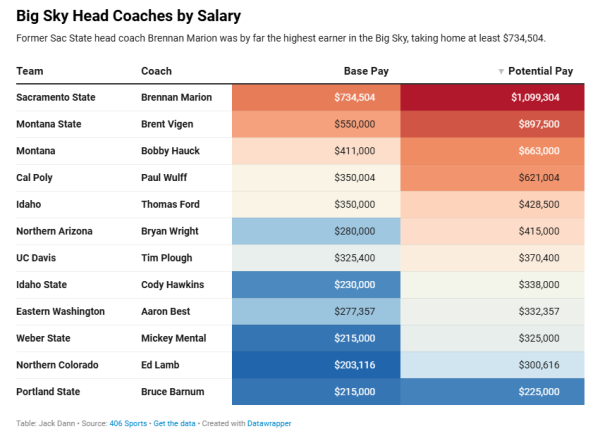
Note: Former Hornet football head coach Troy Taylor was offered $240,000 per season in a seven-year deal under President Nelsen.
And then Alonzo, it was easy. He was, by far, the best candidate for what we want for the future, which is: we need someone who can help guide us into FBS. We need somebody who wants to stay in Sacramento and really be dedicated to this community. We want someone who understands the culture of this region and the campus. Him being from Oakland weighs in heavily on that. We also want someone who’s going to bring a sense of fun and a vibe to the campus. And, you know, what better than a backup dancer from MC Hammer? He knows how to have a good time.
RELATED: BREAKING: Alonzo Carter hired as Sac State football’s newest head coach
Q: I know one of the qualities you mentioned in your KCRA interview was stability in a coach. How does Carter fit into that?
A: Well, what stood out to me is when he told me that he said, “This is the job that I wanted for over 10 years, and I’ve applied to this position four times.” That, to me, demonstrates that he wants to be here and not just to come in and out.
When you think about the people who he’s bringing in, because he’s from this region, you’ll start to see it over the next several days: coaching staff members who are going to decide to stay now and coaches in the local region who are going to decide to come and join. It makes a big difference when you can do that for recruitment.
The other thing I would say is we hired him because he’s an amazing coach. But, it’s a new era where the transfer portal, NIL, revenue share and opting into the House is a whole different world.
Having someone who is rated as one of the top recruiters in the country goes a long way for what we’re trying to build here because we want students who want to come here and compete, stay and graduate. You’ve seen a lot of other institutions where they’re shuffling over the team every year. I really want us to be a place where that’s stable for the students. I mean, for the community at large, but really it is for the students.
Q: With having a coach change so close to the arrival and departure of Brennan Marion, how are you expecting this to impact the team, as well as the FBS bid?
A: Well, in terms of how I think it impacts the team, they’re excited. All I’m hearing is great levels of excitement from the students. So that goes a long way. [Carter] coached high school for 10 years, coached community college for 10 years. So, he knows players on our team; they were part of his youth camps. The level of excitement on the team has been great. And then, you know, for our FBS ambition, we needed somebody who had been at the FBS level, who’s been effective and wins at that level.
RELATED: Portal Watch, tracking Sac State’s offseason roster roulette
Q: So FBS is still on the table then?
A: Absolutely.
Q: I know that you were saying how you have something FBS related to announce in the next few months. Can you tell me anything about that?
A: I’ll say it like this. I’ve been consistent in saying for over a year now that we’re going to be FBS and when people ask ‘does that mean for 2026?’ At this point, I still have every bit of confidence that we’ll be playing FBS in 2026. Well, we plan, I should say, an FBS schedule in 2026. And what that looks like, we’re almost there on. And within that time frame that we discussed, there’ll be something big coming that I think the community will be happy about. And, honestly, [Carter is] an important piece in that puzzle for us.

Q: Tying into the future for sports culture, what was the initial hope when implementing the post-game concerts?
A: Student life, trying to make it so it’s an enjoyable campus for students to be at. And here’s how, because I have to say this.
I’ve heard people say, “Oh, they’re having concerts at the games because they want attendance, and they want to make more money.”
That doesn’t make sense because, if we were going to do that, we wouldn’t get DDG and Lil Yachty. We would get artists that people who are 40 to 60 know, who are going to be the paying customers who are going to come. If you look at the demo of the people who are identified, they were identified because we thought they would do well with our students. And based upon the turnout, they did. If it was about attendance, we would be selecting different artists, trying to get that larger crowd of the older folks to come in and spend their money.
Q: With the influx of students, increasing housing and the live-on requirement, students are starting to become concerned about not only housing but also congestion relating to parking, class availability and livelihood. How is the university planning to address this rapid growth?
A: That’s actually why with the RFQ that we have out right now, that we’re looking for apartment complexes in our local area. For example, there’s a whole bunch of them that are just right here. If you live there, you can just walk across the street, so that would have less of an impact on parking. If you live in Wexler or Academy 65, there’s that entrance that’s right there. And so people won’t necessarily drive. They’ll skateboard, they’ll scooter, they’ll, I don’t know, walk. Having more students living on campus and near campus actually reduces some of that congestion.
I would also say that parking is an issue on campus. I know it is because I struggle with it. So if I struggle with it, and I’ve got a good place to park every day, I know that other people do too. It’s something that we’re focused on and something that we’re going to have to address as we do the next phases of building on this campus. But we’re definitely at a point where we certainly are going to need another one or two parking complexes because it’s just hard for the students to park.
Q: What about increasing campus and off-campus amenities for the increased number of students in the area?
A: We talk with private groups all the time that are looking to either have businesses or performance centers.
It’s also why you’ve seen us do so much more around student life. It’s the concerts. It’s the carnival and the quad. It’s the programming that UNiQUE does. It’s some of the things that you’re going to see next semester. All that’s around building out that campus life so the students are not just here, but they want to be here because there’s stuff happening.
Q: How interconnected is the funding between, say, the post-concert series, the events that UNiQUE is putting on and the events you’re talking about? Can you break down the fee pools for me?
A: So UNiQUE comes from the Union Well Fee. Students pay that fee, and then there’s a portion of that fee that they dedicate to provide funding for UNiQUE to do their program. Then you’ve got the First Year Experience Fee, that’s paying for some of the concerts, NestFest, Convocation and some other things. Then you have an Instructional Related Activities Fee, and that pays for a different set of events and things that are happening.
So they’re actually separate buckets, but most of student life is funded through fees that basically allow for students to have a student life. So the post-game series doesn’t come from tuition at all. It comes from fees that are designed for campus life, and they can only be used for it.
Q: So this money isn’t coming from money that students are putting toward yearly fees when they’re coming here?
A: So we got tuition and fees. There’s tuition that students are paying for their classes. Then you have fees that are happening at two different levels. One is the system-level fees. Then you have local fees that students basically weigh in on, either through alternative consultation or vote. Like, we just had that one last semester – the student success fee that was voted down – it died, like, hard.
What happens is you go through a process, students vote either through an alternative consultation, or just a straight up or down vote. So those buckets include the Union Well Fee, the Instructional Related Activities Fee, the internship fee – they’re all separate ones where you can’t cross the money streams.
That makes it complicated because then people were like, ‘Oh, well, you got all this money that you’re spending on X. How come you can’t do X?’ I was like, well, legally, we can’t.
I will say this. If students in engineering, for example, wanted to have more classes, they could basically have a fee that goes for engineering that they pay a little bit more, and they get way more classes. But here’s where the difference is, when it comes to campus life fees, those go through what’s called alternative consultation (focus groups, feedback sessions). When it goes to anything dealing with classes or academics, it’s a straight up or down vote.
Q: So how would, say, an engineering student implement that fee if they were wanting to get more of those courses? What does that look like?
A: They would probably go to their student body government representative and say that this is something that they want to pursue. Then they would meet with their dean, and then they would move forward on a process that they would propose. If those things are things that students want, they can absolutely advocate for it. But I’m not pushing student fees at this current time, and when the state budget is cutting us, I just can’t add that to the pile.
RELATED: Students express feeling ignored as fees increase
Q: What is the plan in place to address the current shortages across the board of classes?
A: How we tried to address it is we got some additional money from the Chancellor’s Office, and we just opened up 153 more sections. And I can be real, we need 153 more, right? I mean, but at least we were able to do that, which was significantly better than what we thought we were going to be able to offer. When new dollars come in, we use them strategically to ensure that we’re providing the students with what they need. I wish we had more.
Note: Chief of Staff Kristen Tudor said that, as of a week and a half ago, there were still 100,000 seats open, with classes at 80% capacity. Tudor said that the provost is attempting to reach out to advisors to encourage them to talk through class requirements in order to fill remaining seats. She also mentioned that these capacity issues are at an individual course level and affect certain courses, such as lab classes more heavily due to lab space capacity.
Q: This fall semester, there were no in-person town halls, and all plans for in-person meetings were moved virtually. Is there a hope to increase in-person town hall events next semester?
A: Yes, but let me also say this.
So, we post a thing saying that we’re gonna do it in person. Then everyone gets upset that we’re doing it in person because they say, “You’re excluding people who should be able to do it online.” So then we move it online, then everybody is upset that we moved it online.
It was like, “Oh my God, we’re trying. We’re literally just trying to get to the students.” I would also say that even though we didn’t do large town halls, we’ve done tons of meetings – the meetings that we do with student organizations, the meetings that we do with the cultural centers – it’s actually extensive.
Q: And how are students notified of things like this happening?
A: I mean, with the meetings, usually they ask to meet with us.
Note: Tudor spoke up to mention how students will come and meet in the conference room in Sacramento Hall to have coffee and converse with Wood, organized through Hornet Heartbeat.
We always ask [the visiting students] the same question: If you could be president for the day, what would you do different than what I’m doing right now? I don’t think students have thought about it.

I’d also challenge someone to find someone who spends as much time as I do walking around campus to specifically engage students. I mean, that’s not necessarily a normal thing. When I was a student here, that wasn’t something that was normal.
Q: Based on what we hear from students, it sounds like that disconnect is happening from the students that are maybe not tethered to an organization, and want the opportunity to be in a space to observe and ask questions instead of having the barrier of a screen. When you went outside to address the protest in front of your office, it seems like your willingness to engage was received well, would you agree?
A: It’s been very rare that there’s been a protest, even when they’re protesting me, that I don’t go out there and talk to them. I think that that’s important. I actually believe in protesting. There’s no one who protested the President’s Office more than I did when I was a student. So I think that that is important, and I think it’s healthy.
At some point in time in the future, the students who protest me will be in a position of leadership somewhere in their life. I purposely go out and model what people should be doing, even when they’re saying things that, you know, are about me or about their leadership. That’s okay, right? It’s okay to sit in discomfort and to hear what people have to say. That’s why I make it a practice to do that.
Q: And how does that feel, with all of the feedback from students on campus?
A: I’m in alignment. I love this place. I love the students. I’m not here for any other reason other than I want to be able to see Sacramento State win. And so it’s hard. You know, I’m human. It’s hard. And at the same time, if it was easy, then everyone would do it.

Kathryn is the main contributor to the quiz section of LaDailyGazette.com. If you have an idea for a quiz, let us know.