


 Kathryn Sears
Eighty Inland Empire nonprofit leaders spent the past year sharpening leadership and advocacy skills, then fanning out across the Capitol for 75 meetings with state legislators and their staff to press for solutions grounded in what they see every day on the ground.
The effort is part of the Champions for Vibrant Health Leadership Network, a two-year initiative funded by the IEHP Foundation that supports 40 Inland Empire nonprofits by strengthening the skills, networks and capacity of their leaders. Each organization nominates an executive leader and an emerging leader to participate in in-depth leadership training and advocacy experiences. Alongside funding, participants receive coaching and peer support aimed at helping nonprofits grow their impact, become more sustainable and better equipped to pursue long-term policy and collective solutions in the communities they serve.
The 80 leaders recently wrapped their first year together after four in-person sessions, an advocacy trip to Sacramento and a three-day strategy summit to learn, grow and plan for next year. The network is scheduled to convene again in January 2026 and travel to Sacramento in February 2026.
The push comes as nonprofits nationally warn of rising demand and tightening margins. In its 2025 annual review, Independent Sector — a national membership organization for nonprofits, foundations and corporate giving programs — reported that 68% of nonprofits expect demand for their services to increase in 2026, while 81% of surveyed organizations struggled in 2025 to raise enough funds to cover all of their costs.
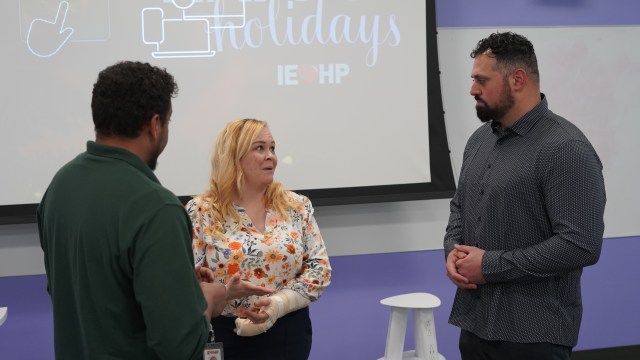
That squeeze surfaced repeatedly in interviews with four participating organizations on Monday, Dec. 15, held at IEHP Foundation in Rancho Cucamonga: Sahaba Initiative, Operation New Hope, Reach Out and Children’s Fund.
Sahaba Initiative Executive Director Malek Bendelhoum said the organization’s services and advocacy focus on stabilizing families while building paths to long-term mobility. “All of our work really centers around helping break individuals and families out of the cycle of poverty by advocating for and providing services around key focus areas, which is hunger, housing, economic stability and well being,” Bendelhoum said.
Asked what feels most urgent in December, Bendelhoum pointed to housing and food. “I would say two things. One being housing… and then number two, food,” he said, describing how the end of the year can push already-strained budgets to the breaking point.
In Sahaba’s housing work, Bendelhoum said the challenge is not only affordability, but safety. “The thing that I hear the most… is how difficult it is to find safe housing,” he said, describing families searching for places where they feel secure letting children play outside and safe simply walking from their car to their home.
Shaheen Nassar, Sahaba’s development and outreach manager, said the organization aims to move beyond crisis navigation by increasing families’ earning power. “We’re in the business of breaking cycles of poverty,” Nassar said. “We don’t just keep people afloat… we help them lift themselves out of poverty by providing vocational training.”
Nassar said the leadership network helped nonprofits bring community realities into policymaking. “This was empowering,” he said, describing the need for working-class and marginalized voices to be part of the political conversation. He added that the cohort pushed against a nonprofit dynamic he often sees when resources are scarce. When organizations compete for limited funding, he said, it can “structurally create this competitive nature,” even when they are ultimately advocating for the same communities.
At Operation New Hope, CEO Russell Degnan and program manager Mario Jacobs described a nonprofit focused on reentry and youth support through wraparound services, including case management, counseling and skill-building.

Jacobs, who oversees youth programming, said group counseling is central to helping young people reframe what they believe about themselves and their futures. “Groups are where the magic happens,” he said, explaining that participants begin to confront “distorted belief systems” — including ideas “that they can’t make it” or that “college isn’t for me.”
Degnan said the leadership network pushed his organization to strengthen internal systems that can be overlooked when nonprofits are forced to respond nonstop to emergencies. He described the need to slow down and be more intentional about onboarding and training so staff aren’t rushed into complex work without support. He also said building stronger managers who can delegate effectively is part of preventing burnout and improving long-term sustainability.
Jacobs said the cohort reinforced what he sees as an often-underestimated advantage for nonprofits. “Nonprofits have a lot of power when they’re pulled together,” he said, describing the difference between one organization advocating in isolation and dozens pushing shared priorities together.
Reach Out emerging leader Daniel Castillo, director of community health and policy, said the organization’s mission is broad by design and grounded in who it serves. “Reach Out’s mission is to strengthen communities,” he said, describing a focus on underserved communities, minorities and people lacking resources. “We want to bridge the gap,” Castillo added, emphasizing Reach Out’s role in bringing people together so communities can become their own leaders.
Castillo said his work in substance use prevention is closely tied to local policy, including social host ordinances aimed at reducing underage drinking. “Legally… the legal drinking age is 21 and over,” he said. He argued the issue is not only enforcement, but long-term harm and normalization. “The brain doesn’t even develop until you’re 25 and older,” he said, warning that allowing teens to drink at home can make it seem acceptable elsewhere.
Castillo said the leadership network’s value is also practical because it creates time and space for collaboration that nonprofits rarely get during daily operations. “One of the biggest things that I have taken away from the Leadership Network is the partner, the partnering, the partnerships that we could build,” he said. “We work better together than in silos.” He said sustainable, unrestricted funding remains a core need for the organization.
Children’s Fund President and CEO Cesar Navarrete and HR/operations manager Cynthia Gonzalez described an organization that supports children across San Bernardino County by funding and equipping partner agencies that provide direct services — filling gaps when other dollars cannot stretch.

In December, Gonzalez said the need became especially visible. “A lot of kids… don’t get a gift during the holidays,” she said, describing the group’s Celebration of Giving campaign and the scale of need across the county. Navarrete said the organization typically aims to collect “30 to 50,000” toys, and Gonzalez said the campaign was “closer to 40,000 this year.”
Navarrete said one recurring challenge is last-minute requests from nonprofits that miss the submission deadline, forcing the organization to rely on a wait list even as holiday events unfold across the region. Gonzalez added that older youth are consistently underserved. “We do have a big need every single year for teen toys for both or all genders,” she said, explaining donors often focus on younger children.
Navarrete also pointed to how policy changes can shift emergency spending. He said a new requirement for landlords to provide refrigerators could free up funds in the organization’s emergency needs program for other essentials. He described families using “ice and… coolers” when they didn’t have a refrigerator, and said the need becomes especially urgent when medication must be kept cold. He also described households with shutoff utilities using risky workarounds, particularly when medical needs require electricity.
Across the four organizations, leaders returned to the same collision of urgency and capacity: responding to immediate crises while trying to build longer-term solutions through policy, collaboration and sustainable funding. IEHP Foundation’s network is designed to make that second track more possible by strengthening leadership, building relationships across organizations and creating a structure for shared advocacy.
“Investing in our local nonprofits is more important than ever to ensure local organizations can address the critical needs that lead to improved community health,” said Greg Bradbard, IEHP Foundation CEO. “With federal and state funding sources declining and needs in our communities on the rise, it’s critical to provide opportunities for nonprofit leaders to grow, connect, and collaborate. By doing so, we not only strengthen our region’s capacity to serve but also empower these organizations to advocate more effectively for those who rely on them.”
After a first year that blended leadership training with Sacramento meetings and strategic planning, the Champions for Vibrant Health Leadership Network is set to reconvene in January 2026 and return to the Capitol in February, with nonprofit leaders aiming to bring a united front to the policy debates shaping the Inland Empire’s future.

Kathryn is the main contributor to the quiz section of LaDailyGazette.com. If you have an idea for a quiz, let us know.