


 Kathryn Sears
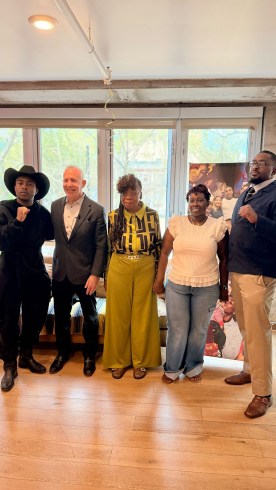
Eight years after Sacramento police shot and killed Stephon Clark in his grandmother’s backyard, his brother Stevante Clark and former Mayor Darrell Steinberg sat down for their first public one-on-one conversation as part of the I AM Sac Stephon Alonzo Clark Foundation Legacy Week.
The sit-down, held March 16 at the Self Design Art Gallery on K Street was moderated by Andru DeFeye and drew a community eager to witness the two men discuss the aftermath of Stephon Clark’s shooting.
Stevante opened by remembering his brother not as a symbol, but as a person. “Everywhere he went, he lit the room up,” he said.
Stephon Clark, 22, was killed on March 18, 2018, in the Meadowview neighborhood of South Sacramento. Officers Terrence Mercadal and Jared Robinet, responding to a 9-1-1 call about a man breaking car windows, pursued Clark into his grandmother’s backyard and fired 20 rounds at him, believing he was pointing a gun.
No firearm was found, just a cell phone. Neither officer was convicted. The shooting sparked protests across the country, with Sacramento demonstrators shutting down Interstate 5 and blocking entry to Kings games.
When asked what those protests were trying to tell the city, Stevante didn’t hesitate. “Fire, charge, and convict the cops who murdered Stephon Clark,” he said. “Anytime you [police] do something so bad where a law must be created, [they] should be held accountable.”
Steinberg acknowledged the moment exposed deep weaknesses in the city he led at the time. Together, the two discussed the protests, the backlash, and what followed; including Assembly Bill 392, known as the Stephon Clark Law, which raised the legal threshold for deadly force in California, making it a last resort rather than simply “reasonable.”
But for Stevante, the policy changes never have been enough without accountability. “Justice for me today would be the officers turning themselves in for murder,” he said. “Justice for me is no more Stephon Clarks.”
According to the Police Scorecard, a Black person in Sacramento was 21/2 times as likely to be killed by police as a white person between 2013 and 2023. Nationally, Black Americans make up roughly 14% of the population but are killed by police at more than twice the rate of white Americans.
For Steinberg, the tragedy demanded a broader reckoning. “Stephon’s death was part of redefining the responsibilities of a city and a city government,” he said. “Cities traditionally have been about providing police, fire, water, utilities, and parks. That’s no longer enough. We need an inclusive economic development strategy.”
South Sacramento, where Clark was killed, has long faced disinvestment and economic inequity.
Since his brother’s death, Stevante has channeled his grief into the I AM Sac Foundation and Legacy Weekend, now in its eighth year. Though Monday marked the first time the two sat down publicly, both men pointed to their long-term friendship as a message that the divide between public officials and everyday citizens can be crossed.
Related

Kathryn is the main contributor to the quiz section of LaDailyGazette.com. If you have an idea for a quiz, let us know.