


 Kathryn Sears
[ad_1]
It’s a given that pollution is adversely affecting health in Northwest Indiana. Scientists are digging deeper to measure the extent.
They gathered at Indiana University Northwest in Gary on Saturday for a discussion of environmental public health in the region. The Northern Lake County Environmental Partnership and Indiana University Northwest’s School of Public & Environmental Affairs sponsored the event.
“There’s so many great things about this part of the state with jobs and industries,” Valparaiso University chemistry professor Julie Peller said, but industries bring pollutants.
Regulations zero in on specific pollutants, but Peller wants a broader picture. “We need to look comprehensively at pollution because it’s affecting all of us,” she said.
Citizens can help connect the dots and influence the science. “It’s not just the scientists. It’s the community all working together,” Peller said.
“The community had every right to feel burned” when scientists stopped work because grants ran out, she said. “We really need community partners now to do each part of our work.”
Allan Halline, a retired gastroenterologist who lives in Ogden Dunes, is part of that effort.
“I just wanted to do something other than just sit back and read books,” he said.
Now Halline is a proponent of green steel production, including direct iron reduction.
“Every day, I could see plumes of smoke coming up from Burns Harbor,” and elsewhere, he said. He’s two miles downwind of Nippon Steel’s Gary Works, which releases over 3,000 tons of particulate matter annually, he said.
“There’s a better way to do this that reduces all the particulate matter, the sulfur, nitrogen oxide, volatile organic compounds, the 180 chemicals known as air toxins, known as carcinogens,” Halline said.
“If you live near a steel mill, you are about a 12% higher risk of developing cancer compared to the national average,” he said. “If you happen to live close to an area that converts coal into coke, a coke oven, that risk actually goes up to 26%, and we have coke ovens in East Chicago and into Porter County.”
“We all know about asthma, emphysema. It goes well beyond that,” Halline said.
“I took care of many patients who had malignancies of the gastrointestinal tract,” Halline said, working at university and Jesse Brown VA hospitals.
In the medical literature, Halline read about how much particulate matters contribute to a host of cancers, autoimmune and neurological diseases, and other conditions.
“Development of these diseases is complex,” Halline said. Sometimes an environmental trigger switches on a disease that otherwise could have remained dormant.
Unlike vaccines, “there’s good data that air pollution contributes” to autism, he said.
Halline pointed to Nippon Steel’s acquisition last year of U.S. Steel, including its Gary Works plant. Nippon has promised to spend $3.1 billion to upgrade Gary Works.
“It kind of makes Gary a sacrifice zone” to put direct reduced iron processes elsewhere but not here, he said. An economic analysis of DRI shows it’s the future of steel production.
If area mills don’t move in that direction, they’ll become obsolete, maybe in 10 to 20 years, Halline figures. “Northwest Indiana will be left with this toxic wasteland.”
“It makes my blood boil to see how the environmental regulations have just rolled back” under the Trump administration, he said. The U.S. Environmental Protection Agency isn’t taking health effects into account for cost-benefit analyses. “It’s just outrageous. How can you do that?”
The most recent assaults on controlling greenhouse gases, Halline said, are “basically pulling a rug out from the Clean Air Act and making it kind of a useless piece of information.”
“The onus should be placed on the industry to prove that it’s safe,” he said.
Research shows the EPA “safe” levels aren’t safe, particularly for marginalized communities like Northwest Indiana, Halline said. “Enforcement is questionable as well.”
“It doesn’t take much to look at the smoke in this area and say this is wrong.”
DRI technology at Gary Works would cost about $2.5 billion. Using natural gas, that would reduce greenhouse gases 50%. Converting to hydrogen would reduce pollution by more than 90%, he said.
Northwest Indiana put forth a plan to build a hydrogen hub here, but the Trump administration killed the project.

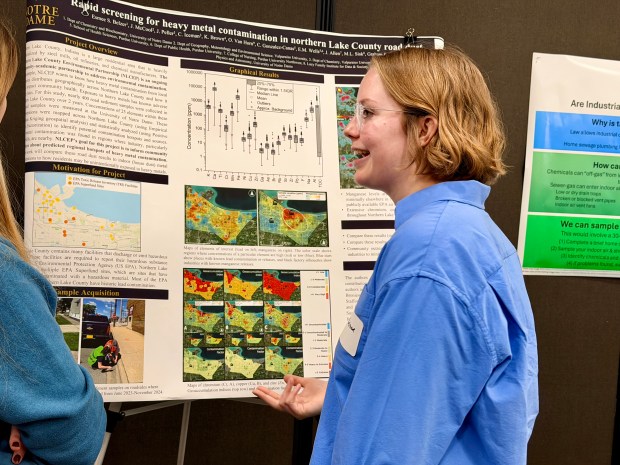
University of Notre Dame PhD candidate Esmee Belzer, an analytical chemist, is working on the environment at a granular level, studying road dust and detecting the spread of lead and other pollutants.
“We all know northern Lake County involves both legacy and ongoing contamination,” she said, but detecting where it is takes effort.
Compounds in the air settle onto the ground. “We collected about 400 different road dust samples,” Belzer said, to see where air emissions ended up. Teams would look for road dust in an assigned sector, often helped by citizens in the area who knew where to look.
Some areas are inaccessible, like inside factory gates, while others aren’t safe to stop a car because of the volume of traffic.
Belzer got the dirt and analyzed it in the lab. She’s not a nuclear physicist but got to use the “cool tools” to do her work.
She used a giant poster to display the results of her work. Manganese clearly came from a particular source, but with other pollutants, the source wasn’t clear because there are so many of them.
Suzanne Chick, a social worker at East Chicago schools, dealt with the lead issue there. “I saw the direct effect of exposure to lead on the kids who used to go to Gosch, where the Blaw Knox factory used to be,” she said.
Susan Duncan, who works for the University of Chicago Center for Global Health, is doing research in sub-Saharan Africa and here. She lives in Whiting.
“Every day I see this black cloud of particulate matter coming out of Cleveland Cliffs at about 5 p.m.,” Duncan said, and wonders what’s in it and what’s in the flares.
Tim DaSilva, an undergrad at Purdue University Northwest, lives in East Chicago.
“I’ve been yelling at the top of my lungs for something to be done,” he said. “I’ve kind of been fighting for a long time as a one-man army.”
Now he’s studying ecology with the ultimate goal of achieving a PhD to help residents in Gary, Hammond, East Chicago and Whiting.
“I live in New Addition, which is surrounded by big polluters,” he said.
The West Calumet complex, “that’s a whole separate can of worms,” DaSilva said. He’s seen people there with mental impairments or born with extra digits. “That area was polluted way before they built that public housing complex on the land.”
Lead has been picked up by the wind and deposited in other sections of the city. “Even though there was a cleanup in West Calumet, a lot of that polluted sediment has been found in other areas,” DaSilva said.

He mentioned another area where arsenic was buried. “They wouldn’t allow us to touch the soil with our bare hands.”
DaSilva gave credit to East Chicago Mayor Anthony Copeland and U.S. Rep. Frank Mrvan for cooperating on a massive cleanup project.
Rachel Schwartz, an attorney with the Conservation Law Center, stressed the importance of building collective knowledge and networks, of building a shared vision of what the environment here can look like.
“This is definitely a moment to be leaning in,” she said.
Doug Ross is a freelance reporter for the Post-Tribune.
[ad_2]

Kathryn is the main contributor to the quiz section of LaDailyGazette.com. If you have an idea for a quiz, let us know.