


 Kathryn Sears
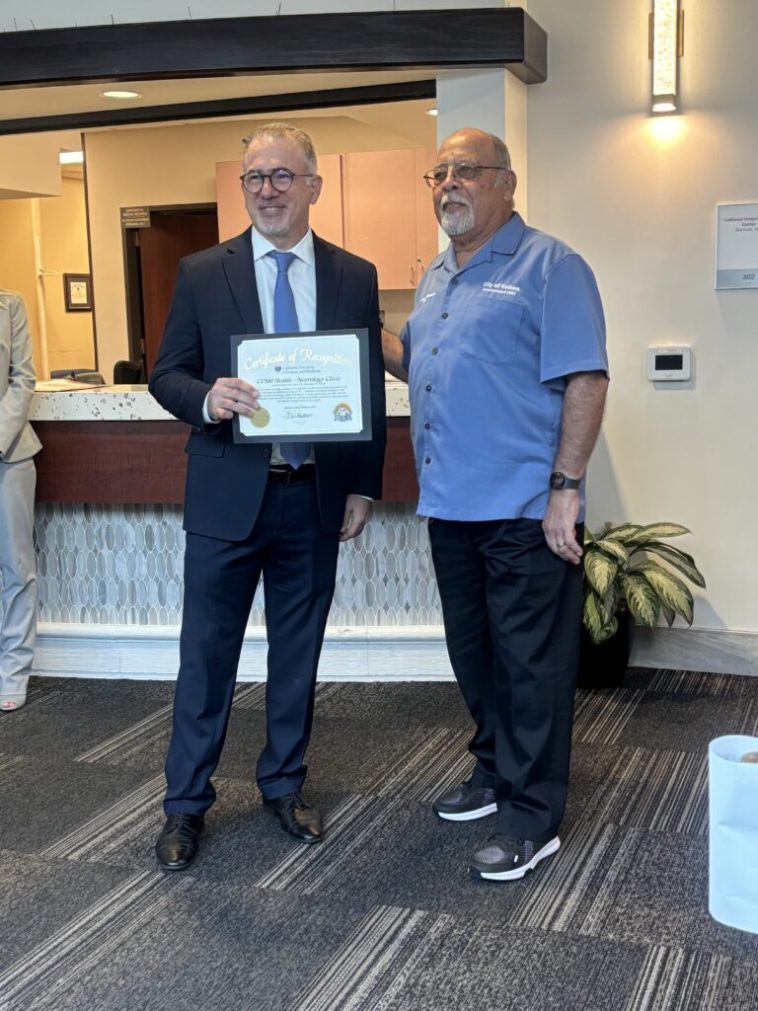
The California University of Science and Medicine marked a significant expansion of specialty healthcare access Feb. 6 with the ribbon cutting and grand opening of its CUSM Health Neurology Clinic in Riverside, a move aimed at addressing longstanding physician shortages across the Inland Empire.
University leaders, elected officials and business representatives gathered at the new clinic at 4646 Brockton Ave., Suite 302, describing the milestone as more than the opening of a medical facility. Speakers said it reflects a broader commitment to advancing healthcare access, medical education and specialized treatment for Inland Empire residents.
Representatives from the Redlands and Riverside Chambers of Commerce attended alongside dignitaries and their representatives, including Colton Mayor Frank Navarro, state Sen. Eloise Gómez Reyes, Assemblymember Sabrina Cervantes and San Bernardino County Supervisor Joe Baca Jr.
Although CUSM’s main campus is based in Colton, university officials said expanding into Riverside was a strategic decision to reach more patients across both Riverside and San Bernardino counties, which face persistent gaps in specialty care availability.
Dr. Andres Gonzalez, chief medical officer for CUSM Health, said the clinic focuses on treating complex neurological conditions, particularly movement disorders such as Parkinson’s disease and multiple sclerosis.
“This is twofold,” Gonzalez said. “One is a clinic that provides two specialty services, both in neurology. One is movement disorders. Movement disorders specialize in things like Parkinson’s disease. And the second one is multiple sclerosis.”
The clinic provides treatment for a broad range of neurological conditions, including vascular and stroke-related disorders, epilepsy, memory disorders, neuromuscular diseases and multiple sclerosis. Services include infusion therapy for multiple sclerosis, therapeutic Botox treatments and deep brain stimulation for Parkinson’s disease.
Gonzalez said infusion therapy represents a major advancement in neurological treatment, offering the ability to slow disease progression rather than only addressing symptoms.
“An infusion is really a way to halt the progression of the disease, and that’s really rare in medicine,” Gonzalez said. “Most of the time in medicine, we treat conditions to keep them from getting bad, but usually it doesn’t change the progression of the disease. So with these infusions, we actually change the progression of the disease.”
The clinic currently operates with two neurologists, along with Gonzalez, a nurse practitioner, infusion nurse and administrative staff. The facility includes examination rooms and a dedicated infusion therapy room designed specifically for patients receiving advanced neurological treatments.
Healthcare leaders say expanding specialty care access in Riverside is critical, as the Inland Empire has significantly fewer physicians per capita compared with neighboring regions such as Los Angeles and Orange counties.
“When we compare the number of physicians per 100,000 people, the density of physicians is half of what it is in LA County and Orange County,” Gonzalez said. “Specialty care usually has about 150 physicians per 100,000 people. In Riverside, it’s 75.”
Those shortages contribute to extended wait times for patients seeking neurological care, often delaying diagnosis and treatment. Gonzalez said the new clinic is designed to significantly reduce those delays.
“Most of the time, if you want to see a neurologist, it takes about three months to get an appointment,” Gonzalez said. “We can get you within one or two weeks.”
The clinic accepts a wide range of insurance providers, including Medicare, Medi-Cal, Inland Empire Health Plan and Blue Cross Blue Shield, expanding access for patients regardless of income or coverage type.
University officials said the clinic also aligns with CUSM’s core mission of training physicians who remain in the Inland Empire, helping address the region’s healthcare workforce shortage.
“We have a medical school right in their neighborhood, in Colton,” Gonzalez said. “The medical school is really focused on two things. One is to bring and create physicians that will stay in the community. The second component is to be able to offer specialty and primary care to our community.”
Gonzalez said limited access to healthcare remains one of the most significant barriers facing Inland Empire residents, particularly in specialty fields such as neurology.
“Ultimately, if you don’t have access to care, you’re not going to be healthy,” Gonzalez said. “The only way to really change the health and well-being of the community is by offering services that are accessible to the people.”
Although the clinic has already been treating patients for approximately nine months, officials held the ribbon cutting to formally mark its opening and recognize its role in expanding specialized care across the region.
CUSM leaders said the new neurology clinic represents an early step in broader efforts to strengthen healthcare infrastructure in the Inland Empire by improving access to advanced treatment while developing a pipeline of physicians committed to serving the community.

Kathryn is the main contributor to the quiz section of LaDailyGazette.com. If you have an idea for a quiz, let us know.