


 Kathryn Sears
Since the beginning of our species’ history, we have used the stars to propel us forward. The stars allowed us to navigate the vast oceans and diverse continental landscapes of our Earth. We used the stars and planets to figure out that we were orbiting the sun, and that the Earth was not at the center of our universe. The stars told us the time, served as the backdrop to love songs and the inspiration of great paintings.
According to an article published in the journal ScienceAdvances in June of 2016, one-third (approximately 33.333%) of humans cannot see the Milky Way, Earth’s home galaxy, because of artificial light pollution. That is 2.66 billion people who cannot see the galaxy our ancestors stared up at, which made them consider their places in the universe. This is a huge, and largely hidden, loss. For the last several decades, the rapid growth and industrialization of our species has resulted in the silent death of the starry night sky for 80% of the world. It is something those who have never had it will never notice and flies under the radar of nostalgia, fading from the memory of the masses.
“I think not being able to go somewhere dark and observe the Milky Way [is becoming] more limited more and more as time goes on,’’ says Nancy Montegue-Archer, an adjunct astronomy professor at American River College. “I don’t know if it’s just a personal thing, wanting people to experience that. It’s pretty awesome.”
There is more that is being lost to excessive and pollutive use of artificial light beyond losing the ability to see the stars.
There is a saying that you can’t have light without darkness, but with the use of artificial lighting, humanity has hacked this concept to the point that there are cities that produce so much artificial light that night is just another time of day. In the modern age, night often seems like an inconvenience. The onset of artificial light has made it possible for us to get more time out of our days and offered more time flexibility, but is this flexibility really worth the cost of sleep?
Despite the growing epidemic of the idea that sleeplessness is just a part of life in our world, sleep is essential for our survival, as well as the survival of most creatures. Sleep resets our nervous systems so we can have clear heads and healthy bodies. The onset of artificial light has made sleep something else–a luxury. Chronic lack of sleep can damage our cognitive ability, cause mental health crises like mania, and lead to increased risk of diabetes and heart disease.
This overexposure of light affects more than just our connection to each other, the past and to space and health, however. It also impacts the health of our planet as a whole. Even though humans may not need to be nocturnal creatures, we absolutely depend on nocturnal ecosystems for our survival.
All ecosystems we gather any type of resource from have night cycles that are essential for not only the survival of the individual plants and animals that make up an ecosystem, but the whole ecosystem itself. While some animals like coyotes and raccoons are adapting well to their changing world, others are not. Several nocturnal or night-dependent species like owls, salmon, bats, song birds, fireflies and sea turtles are just among the few creatures impacted by the unprecedented issue that artificial light pollution causes. Plants that are pollinated by nocturnal creatures or only bloom at night are also impacted by this issue.
These complications are compounded for animals that not just depend on darkness, but ones that depend on the stars specifically. A prime example of such a creature is the indigo bunting, a migratory songbird that travels between North and Central America. Using the pattern of stars surrounding the center of celestial rotation (the way stars and celestial bodies appear to “move” as the Earth rotates on its axis) the birds are able to figure out the direction they are going by pinpointing the poleward region of the sky.
The indigo bunting, and likely several other species of migratory birds, depend on the stars to navigate between their migration points, and without the stars, they can get lost. This phenomenon also impacts moths, dung beetles and other light-attracted species of insects.
The onset of artificial light has made it possible for us to get more time out of our days, but at what cost? All living things depend on the night to sleep, hunt, grow, navigate and/or reproduce, and our species’ dependence on artificial light is throwing the entire world off its delicate day/night cycle balances.
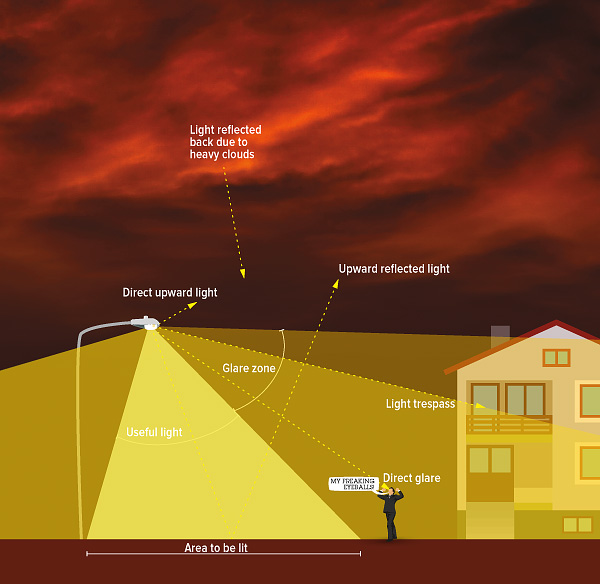
While it is unlikely that light pollution will ever be fully eradicated, especially in big cities such as Sacramento, which has a Bortle Score (light pollution rating scale) of 8.1 out of 9, not all hope is lost. There are many things large communities like Sacramento can do to help reduce the impact of artificial light on our ecosystem. We can implement smart lighting procedures by using dimmable LEDs, passing legislation on overly bright LED headlights in cars, integrating natural light into urban design developments, regulating outdoor advertising and adopting full cut-off light fixtures, just to name a few.

As humanity continues to dominate the Earth, it is easy to forget that we are part of nature too. Without the resources we found in nature, we would not have survived the earliest stages of our existence, and definitely would not have gotten to the point where we were blessed enough to take it for granted.
As members of the natural world, we find ourselves in the unique position that no other creature in recorded and unrecorded history has been in–a position to fix what is broken. The birds, bats and bugs don’t understand why their world is changing and getting brighter and brighter every year. Humans not only understand the problem, but we also understand its intricacies and how to fix them.
Light pollution is definitively the failing of humanity. If we never existed, neither would this problem. It is up to us to change the world to be better, not just for us, but for our natural neighbors as well. While the major changes will take time and effort, there is something everyone can do–provide education to your friends, families and neighbors about the impact of light pollution and work together to make our communities less polluted by light. A good way to start this education is to have an understanding of the Bortle score which is used by astronomical organizations around the world, like the European Southern Observatory and Dark Sky International to help determine light pollution impacts, and the best way to fix the problems caused by light pollution. The next is to ensure your home is not contributing to light pollution by checking outdoor lighting, and changing car headlights to be warmer tone LEDs. We can all make small changes to help correct the harms caused by light pollution.

Kathryn is the main contributor to the quiz section of LaDailyGazette.com. If you have an idea for a quiz, let us know.