


 Kathryn Sears
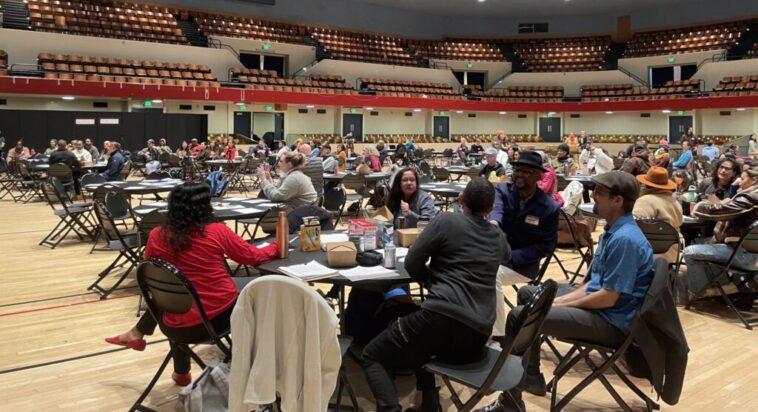
Dozens of community members gathered at Richmond Memorial Auditorium Wednesday to imagine Richmond’s economic future, expressing concerns about economic hardship, pollution and a lack of community spaces.
The event is part of a series called “Our Future Economy,” which the UC Berkeley Othering & Belonging Institute is hosting along with the mayor’s office to devise ways to transform the economy for communities, workers and climate well-being. Othering & Belonging says on its website that Richmond was selected for a number of reasons, including its connection to Chevron and the fossil fuel economy, and its movement toward tax and energy measures that are considered progressive.
Luna Angulo, the event emcee from the climate action group Just Transition Listening Project, spoke about Richmond’s “climate justice principles” and strengths that include an active population, which has enabled community-oriented projects like the RYSE Center for youth and Urban Tilth’s North Richmond Farm.
Eli Moore, of Othering & Belonging, talked about the economic and environmental realities in Richmond, where the Chevron Richmond Refinery is the city’s largest employer and polluter. Moore said the refinery is the second largest emitter of greenhouse gas in the state. Pointing to the MIT Living Wage Calculator, Moore said a single parent with a child in Contra Costa County would need to make $120,000 a year to cover living expenses.
Most of the evening was interactive, with participants, both in person and online, asked to use a digital bulletin board to respond to the question: What ideas do you have for how our economy can be transformed to make the good life possible? Responses included: lowering fire danger and building a greener infrastructure, as well as having well-paid jobs, greater access to the bay, community potlucks and more time to spend with family.

Mwende Hinojosa expressed frustration with having so many corporate retail chains. Other residents also talked about the importance of boosting the local economy.
“Every dollar I spend goes to Richmond businesses,” Hinojosa said. “When I buy food, it’s from a local farmer. When I buy essential items, they were manufactured in Richmond.”
The environment is another high priority for community members, with several mentioning green spaces, air quality and water cleanliness. They suggested more bike lanes, an urban farming community and a biological water treatment plant that would clean wastewater using natural processes.
Many related to the ways in which the Chevron refinery affects the city’s overall quality of life — culturally, economically and environmentally.
Diego Arana voiced concern about how economic and environmental progress may affect labor.
“Where do the workers go?” he asked.
Labor was a recurring topic, with calls for unionized, well-paying jobs that allow workers to have their basic needs met without their employer harming the community.
Contra Costa County Supervisor John Gioia said the county wants to attract high-paying green industry jobs and move away from fossil fuels. He said the residents’ input will be helpful in advancing this effort.
The next session in the “Our Future Economy” series will be from 6 to 9 p.m. on Thursday, March 20, at the Nevin Community Center, 598 Nevin Ave.
(Top Photo of Luna Angula, by Daniela Castillo)
Richmond launches plan to convert dozens of homes from gas to electric energy

Kathryn is the main contributor to the quiz section of LaDailyGazette.com. If you have an idea for a quiz, let us know.